


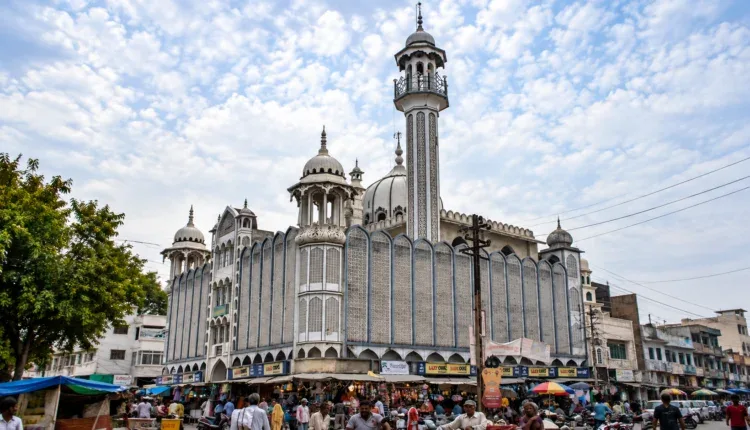





Tensions have risen around the Shahi Masjid after the Ujjain Municipal Corporation moved to remove a portion of the mosque as part of a road-widening project.
The road is planned to be widened to 15 metres under the Ujjain Development Plan 2035. Authorities say the project is intended to improve traffic movement and public facilities ahead of Simhastha 2028, a major Hindu pilgrimage expected to bring very large numbers of devotees to Ujjain.
The portion identified for removal reportedly includes part of the prayer hall, a 120-foot minaret and the area known as Mazhar Chouk Shahi, according to the mosque’s petitioners. The mosque is registered as a Waqf property.
Muslim residents and mosque representatives have opposed the action, arguing that the road should be widened without affecting the religious structure. Hundreds of people gathered at the mosque, with some remaining there overnight in an attempt to prevent the removal.
Protests and Police Deployment
The dispute intensified over the weekend of September 26–28, 2026. Large numbers of Muslims gathered around and inside the mosque as authorities prepared to carry out the planned work.
Reports on September 28 said clashes occurred between protesters and police, with stone-pelting reported and police using tear gas to disperse crowds. Heavy security forces were deployed around the site.
Earlier, police officials said the administration was attempting to resolve the matter through dialogue rather than immediately carrying out demolition. Ujjain Superintendent of Police Pradeep Sharma said authorities were trying to persuade mosque representatives to cooperate with the process.
Why Does the Government Want the Structure Removed?
The Madhya Pradesh government and Ujjain Municipal Corporation say the action is part of a wider road and infrastructure programme linked to preparations for Simhastha 2028.
The disputed road runs near the Mahakaleshwar Temple and the Kshipra River, an area expected to experience major increases in pedestrian and vehicular movement during the pilgrimage.
In its September 9 order, the Madhya Pradesh High Court noted the expected arrival of crores of devotees during Simhastha and the need for traffic management, public facilities and safety. The court found that the municipal authorities had followed the required legal procedure.
The court also noted that the road-widening programme had affected other religious structures. According to the judgment, portions of 10 temples and one mosque had already been removed along the same road, while action had been taken involving about 80 religious places across Ujjain.
The Mosque’s Claimed History
The Shahi Masjid is described by local Muslim representatives as a centuries-old mosque.
Its imam, Mohammad Ibrahim, has claimed that the mosque dates to 1390, making it approximately 636 years old in 2026. He has described it as one of Ujjain’s oldest religious sites.
That historical claim should be distinguished from independently established architectural records. Available reporting on the current dispute primarily attributes the 1390 date to the mosque’s imam and local Muslim representatives, rather than presenting it as an independently verified archaeological finding.
The mosque’s administrators have also described the structure as an ancient religious property that has existed for generations. The legal proceedings identify it as a Waqf property administered by the Shahi Masjid Waqf Panchayat Mochiyaan.
An Important Historical Complication
There is also a historical record involving another Shahi Masjid in Ujjain that should not automatically be treated as the same building.
An Archaeological Survey of India-related historical publication available through the Indira Gandhi National Centre for the Arts describes a Shahi Masjid located near the Mahakaleshwar Temple and says a Persian inscription on that structure records construction beginning during the reign of Jahangir and being completed during the reign of Shah Jahan in AH 1041 (AD 1632). The publication also describes an adjoining mahal and graveyard associated with the mosque.
Because current reports about the mosque at the centre of the 2026 dispute identify its date as 1390, while the historical architectural record cited above gives 1632 for a Shahi Masjid, these should not be conflated without further archaeological or documentary evidence.
What the Madhya Pradesh High Court Decided
The dispute reached the Madhya Pradesh High Court after mosque administrators challenged notices issued by the Ujjain Municipal Corporation.
On September 9, 2026, Justice Sandeep N. Bhatt dismissed two petitions challenging the proposed removal. The court held that the municipal authorities had followed the applicable legal process and had provided the affected parties an opportunity to raise objections.
The petitioners had argued that the action would affect part of the prayer hall, the minaret and Mazhar Chouk Shahi and had raised constitutional concerns under Articles 14, 25 and 26, as well as property-rights concerns under Article 300A.
The court rejected the claim that the mosque was being singled out because it was a religious structure, citing the action already taken against other religious properties in the road-widening programme.
The mosque’s representatives subsequently pursued further legal relief, with another hearing scheduled as the dispute continued to develop on the ground.
Why the Dispute Has Become Sensitive
For the Muslim community in Ujjain, the issue concerns the preservation of a place of worship that local representatives say has existed for centuries.
For the authorities, the matter is part of a larger infrastructure project intended to prepare the city for one of the country’s major religious gatherings.
The disagreement therefore involves two competing claims: the administration’s stated need to widen roads and manage large crowds during Simhastha 2028, and the mosque community’s demand that the religious structure be preserved and that alternative arrangements be considered.
As of September 28, 2026, the dispute remains active, with protests continuing around the mosque and legal proceedings still forming part of the community’s efforts to challenge or modify the proposed action.
Historical note: The most important point when reporting the mosque’s history is to distinguish the 1390 date claimed by its imam and local representatives from the separate historical record describing a Shahi Masjid completed in 1632. The available sources do not establish conclusively that these two historical references concern the same structure.