











By Tariq Iqbal Chaudhry

When Fighting Nature Turned Into a National Tragedy
Public health campaigns are often launched with the goal of protecting lives, but history shows that policies implemented without fully understanding nature can produce catastrophic consequences.
One of the most striking examples is China’s Four Pests Campaign, launched by Chairman Mao Zedong in 1958. Intended to improve public health and boost agricultural production, the campaign instead disrupted the country’s ecological balance, contributing to massive locust infestations, crop failures, and one of the deadliest famines in modern history.
The campaign targeted four species regarded by the Chinese government as harmful to public health and food production: rats, mosquitoes, flies, and sparrows. While eliminating disease-carrying pests appeared logical, the decision to eradicate sparrows proved disastrous.
Historical estimates suggest that nearly one billion sparrows, 1.5 billion rats, millions of tons of flies, and countless mosquitoes were destroyed during the nationwide campaign. Scientists later concluded that the elimination of sparrows removed one of nature’s most effective predators of crop-destroying insects, allowing pest populations to explode across China’s farmlands.
Today, the Four Pests Campaign is widely regarded by historians and environmental experts as one of the world’s most significant examples of ecological mismanagement caused by government policy.
China Before the Campaign
When the People’s Republic of China was founded in 1949, the country faced enormous public health challenges. Decades of war, poverty, and underdevelopment had left millions vulnerable to infectious diseases.
Tuberculosis, cholera, plague, malaria, polio, smallpox, and other communicable diseases claimed hundreds of thousands of lives each year, posing a major obstacle to the new Communist government’s efforts to rebuild the nation.
In response, Mao Zedong’s government introduced sweeping healthcare reforms. Nationwide vaccination campaigns were launched, access to clean drinking water was expanded, sanitation systems were improved, and medical workers were deployed to rural communities where healthcare had previously been almost nonexistent.
These initiatives significantly improved public health and demonstrated the government’s determination to modernize China. However, Mao believed that disease control alone was not enough. He argued that the animals and insects responsible for spreading disease or damaging crops also had to be eliminated.
That belief would soon lead to one of the most controversial environmental campaigns in modern history.

Mao Zedong’s Vision and the Launch of the Four Pests Campaign
Mao Zedong remains one of the most influential—and controversial—political leaders of the twentieth century. After leading the Communist Revolution to victory in 1949, he founded the People’s Republic of China and ruled the country for nearly three decades.
Determined to transform China from a poor agrarian society into a modern socialist state, Mao introduced a series of ambitious national programs. Among the most significant were the Great Leap Forward and the Four Pests Campaign, both designed to increase agricultural production, improve public health, and accelerate economic development.
In 1958, the Chinese government concluded that treating diseases alone would not be enough. Officials argued that animals and insects responsible for spreading disease or reducing food production should also be eradicated.
As a result, the government launched the nationwide Four Pests Campaign, targeting four species officially designated as enemies of the people:
- Rats
- Mosquitoes
- Flies
- Sparrows
According to official policy, rats, mosquitoes, and flies spread disease, while sparrows were accused of consuming large quantities of grain that could otherwise feed the population. Authorities believed that eliminating sparrows would significantly increase agricultural output and help address China’s growing food demands.
A Nation Mobilized Against Sparrows
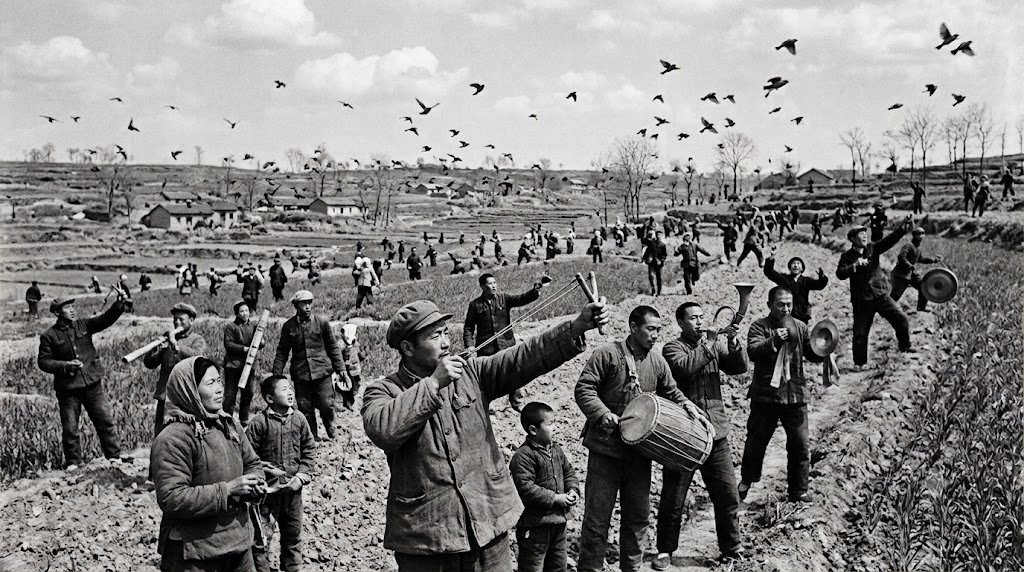
The campaign quickly became a nationwide mass movement. Schools, factories, government offices, and local communities were instructed to participate. Millions of Chinese citizens—including children, teachers, workers, soldiers, and government employees—joined the effort.
People beat drums, pots, pans, and metal containers for hours to prevent sparrows from landing and resting. Exhausted after prolonged flight, many birds fell from the sky and died. Others were killed with slingshots and nets, while nests were destroyed and eggs smashed.
Government posters, newspapers, rallies, and public meetings encouraged citizens to eliminate the "Four Pests” in what was presented as a patriotic duty. Participation became a symbol of loyalty to the Communist government.
Initially, officials celebrated the campaign as a remarkable success. Reports claimed that millions of sparrows had been eliminated and predicted that grain production would rise dramatically.
However, scientists and agricultural experts soon began observing alarming ecological changes. They discovered that sparrows did not feed solely on grain—they also consumed vast numbers of locusts, caterpillars, and other crop-destroying insects.
With the sparrow population devastated, these insect populations multiplied rapidly, setting the stage for an environmental disaster that would have devastating consequences for China’s agriculture.
When Nature Fought Back
The consequences of the Four Pests Campaign became evident far sooner than Chinese officials had anticipated. As sparrow populations collapsed, the natural balance of China’s ecosystem was severely disrupted.
Scientists and agricultural experts soon realized that sparrows were not simply grain-eating birds. They were also among the most effective natural predators of locusts, caterpillars, grasshoppers, and other crop-destroying insects.
Without sparrows to keep these pests under control, insect populations exploded across large parts of the country. Massive swarms of locusts and other agricultural pests descended on farmland, destroying crops on an unprecedented scale.
Instead of increasing food production, the campaign contributed to widespread crop losses and intensified the challenges facing China’s agricultural sector.
The Great Chinese Famine
At the same time, China was implementing Mao Zedong’s Great Leap Forward, an ambitious economic and agricultural program intended to rapidly industrialize the country.
However, a combination of collective farming, unscientific agricultural practices, inflated production figures, excessive state grain procurement, and adverse weather conditions created a perfect storm for disaster.
The ecological damage caused by the destruction of sparrows further worsened the food crisis.
Between 1959 and 1962, China experienced what is now known as the Great Chinese Famine, one of the deadliest famines in recorded history.
Historians continue to debate the exact death toll. Conservative estimates suggest that 20 to 30 million people died, while several academic studies place the number at more than 40 million, making it one of the worst human catastrophes of the twentieth century.
Today, many historians agree that although the famine resulted from multiple political, economic, and environmental factors, the Four Pests Campaign significantly contributed to the ecological imbalance that accelerated the agricultural collapse.
The campaign has since become one of the world’s most frequently cited examples of how large-scale environmental interventions, when undertaken without adequate scientific understanding, can produce devastating and unintended consequences.
China Admits Its Mistake
As the ecological consequences became impossible to ignore, Chinese authorities eventually acknowledged that eliminating sparrows had disrupted the country’s natural ecosystem.
In 1960, the government officially removed sparrows from the list of the Four Pests and replaced them with bedbugs, recognizing that sparrows played a vital role in controlling insect populations that threatened agricultural production.
To help restore ecological balance, China later imported approximately 250,000 Eurasian Tree Sparrows from the Soviet Union. Although historical records do not clearly identify the exact regions where the birds were collected or released, researchers believe they were gradually reintroduced into several affected provinces over a number of years, allowing sparrow populations to recover.
A Lasting Lesson for the World
Today, the Four Pests Campaign is studied worldwide by historians, environmental scientists, agricultural experts, and public policy researchers as a powerful example of the unintended consequences of poorly informed government policies.
The campaign demonstrated that every species plays an important role in maintaining ecological balance. Removing one component of an ecosystem without scientific evidence can trigger a chain reaction with devastating environmental, economic, and humanitarian consequences.
While the campaign formed part of China’s broader effort to improve public health and modernize the country, it also became a cautionary tale about the dangers of political decision-making that ignores scientific expertise.
More than six decades later, the story of the Four Pests Campaign continues to serve as a reminder that nature operates through complex ecological relationships. Attempts to reshape those relationships without understanding them can produce consequences far beyond what policymakers ever intended.
For many historians, the campaign remains one of the most significant environmental disasters of the twentieth century—illustrating how well-intentioned policies, when implemented without sound science, can contribute to one of history’s greatest human tragedies.