








Urdu Report Editorial Team
China’s renowned smart electric vehicle company XPENG is no longer limited to manufacturing electric cars for roads. The company is rapidly expanding into artificial intelligence, autonomous driving, robotics and air mobility.
XPENG AeroHT, a company associated with XPENG, is developing a flying car that can travel on the ground and, when required, separate its built-in electric aircraft and take to the skies.
Aircraft Separates from Vehicle with One Click
XPENG has showcased various demonstrations of the advanced technology behind its Land Aircraft Carrier. In a video shared by the company, the flying module can be seen separating from the ground vehicle with a single click.
After completing the flight, the aircraft reconnects with the ground vehicle. The automated system is designed to make the use of flying cars easier and more convenient for consumers.
What Is the Land Aircraft Carrier?
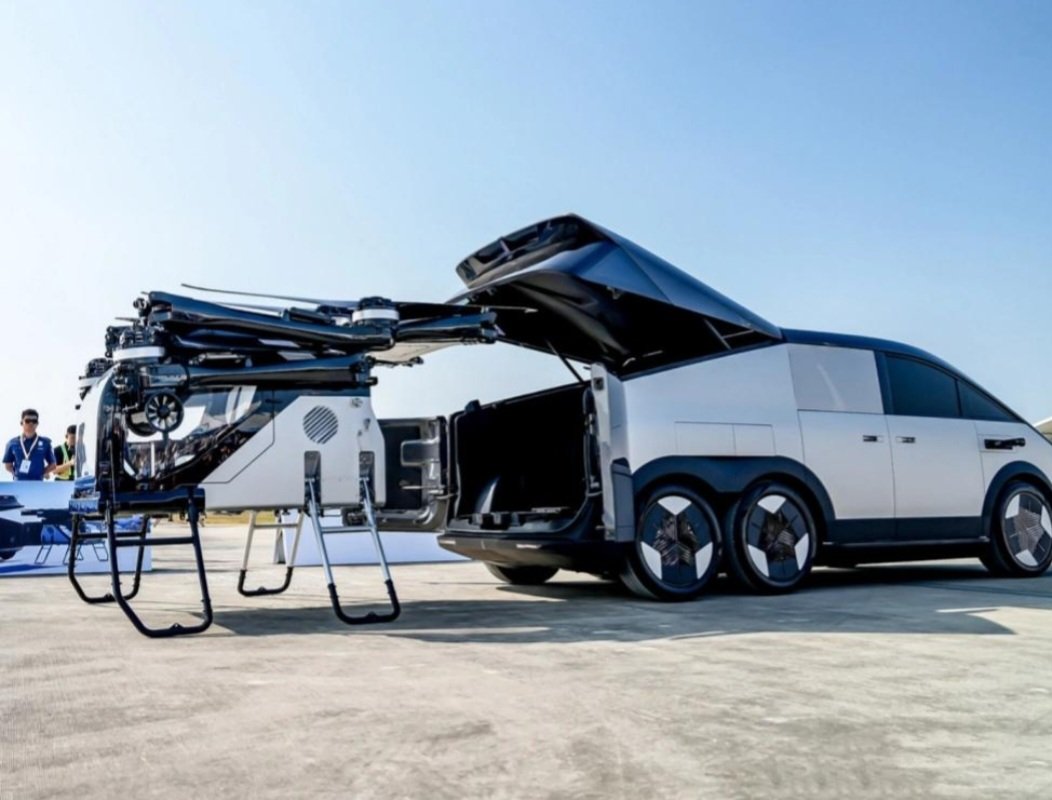
The Land Aircraft Carrier is essentially a modular flying car consisting of two main components. The first is a large electric ground vehicle, while the second is an electric eVTOL aircraft.
The flying module is stored inside the ground vehicle. When air travel is required, it is separated from the vehicle, its flight systems are activated, and it can take off vertically.
The concept aims to provide both ground and aerial transportation through a single mobility system.
Technology Demonstrated on Snow
In a recent video, XPENG demonstrated the system operating in challenging environments such as snow. The company says its automated separation and reconnection technology has been tested under different conditions.
The snow test is considered significant because a flying car would need to operate reliably in a variety of weather and ground conditions if it is to become a practical mode of transportation in the future.
Xpeng Plans Mass Production of Flying Cars
via @Currentreport1#Engineering #Robotics #AI #Innovation pic.twitter.com/DBEMswr7kr— VisiveAI (@VisiveAI) August 13, 2026
Automated Reconnection Facility
One of the notable features of the Land Aircraft Carrier is the ability of the flying module to automatically reconnect with the ground vehicle.
Traditionally, separating and reconnecting an aircraft with a vehicle could require human intervention. However, XPENG aims to automate this process as much as possible.
Which Famous Vehicles Has XPENG Produced So Far?
It would be inaccurate to view XPENG solely as a flying-car company. Over the years, the company has developed several electric vehicles, AI systems, autonomous-driving technologies and robotics products.
| Product or Technology | Type | Brief Introduction |
|---|---|---|
| XPENG G6 | Electric SUV | A smart coupe-style electric SUV |
| XPENG G9 | Premium Electric SUV | A large SUV featuring advanced AI and fast-charging technology |
| XPENG P7 | Electric Sedan | One of the company’s well-known sporty electric sedans |
| XPENG P7+ | AI Smart Sedan | A next-generation electric fastback sedan |
| XPENG X9 | Electric MPV | A large and advanced electric MPV |
| MONA M03 | Electric Sedan | A model developed for a relatively broad consumer market |
| Land Aircraft Carrier | Flying Car | A system combining a ground vehicle with a separate eVTOL aircraft |
| AI Robot IRON | Humanoid Robot | A humanoid robot and Physical AI project |
| Robotaxi | Autonomous Taxi | A future taxi based on autonomous-driving technology |
| Turing AI Chip | AI Chip | A chip developed for vehicles, robots and eVTOL aircraft |
| XNGP | Driving System | An AI-based intelligent driving technology |
XPENG’s current global website features several models, including the G6, G9, X9, P7 and P7+.
G6 and G9: XPENG’s Well-Known SUVs
The G6 and G9 are among the company’s key electric SUVs. Both vehicles focus on advanced electric powertrains, fast charging and smart-driving technology.
XPENG has also highlighted 800V high-voltage platforms and high-speed charging technology in its latest-generation models.
The first flying car made by XPENG, dubbed the "Land Aircraft Carrier," made its first public flight in a China airshow.
🎥: Xpeng Aeroht pic.twitter.com/GK9CaZZozm
— CONTEXT VIDEOS (@Context2X) February 26, 2025
P7 and P7+ Electric Sedans
The P7 is regarded as one of XPENG’s most recognizable electric sedans. The company later introduced the P7+, placing even greater emphasis on AI and advanced driving technology.
The P7+ has been presented by the company as a next-generation AI smart sedan.
X9: Large Electric MPV
The XPENG X9 is a large electric MPV featuring multiple seats, advanced technology, an 800V platform and rear-wheel steering.
The vehicle is particularly aimed at consumers looking for a large family-oriented or premium electric MPV.
MONA M03: A Relatively Affordable Electric Car
The MONA M03 is an important model in XPENG’s strategy because it aims to bring modern electric and smart technology to a relatively wider consumer base.
The model represents XPENG’s effort to expand beyond the premium vehicle segment and establish a stronger presence in the mass market.
XPENG’s AI and Autonomous Driving Technology
XPENG is also rapidly advancing artificial intelligence and autonomous-driving technology in its vehicles. The company’s XNGP system is an important part of its smart-driving and driver-assistance technology.
The company aims to transform its vehicles from simple electric machines into smart platforms capable of understanding their surroundings and assisting drivers in different driving conditions.
XPENG’s Humanoid Robot IRON
XPENG’s activities are not limited to vehicles. The company has also introduced a humanoid robot called IRON, which it describes as part of its Physical AI strategy.
The company is working to connect robotics with future mobility, artificial intelligence and industrial applications.
Moving Toward Robotaxis
XPENG is also working on Robotaxi technology in the autonomous-driving sector. Its goal is to develop vehicles that could eventually transport passengers from one location to another without a human driver.
This technology could bring significant changes to urban transportation systems in the future. However, safety, legal and regulatory approvals will be crucial for its deployment.
What Is the Turing AI Chip?
As part of its AI strategy, XPENG has also developed the Turing AI Chip. According to the company, the chip is designed for AI-powered vehicles, robots and eVTOL aircraft.
This means XPENG is not relying solely on vehicle design or electric motors but is also incorporating core computing and artificial-intelligence systems into its technology ecosystem.
XPENG AeroHT and the Flying Car Project
XPENG AeroHT is the company associated with XPENG’s flying-car project, while the Land Aircraft Carrier is its most prominent development.
The company is presenting a vision of the future in which a person can begin a journey in a ground vehicle, use the flying module when faced with traffic or difficult terrain, and then reconnect it to the ground vehicle to continue the journey on roads.
Mass Production of the Flying Car
XPENG AeroHT has also established a dedicated factory for the mass production of the Land Aircraft Carrier. According to the company, the planned annual production capacity of the facility is 10,000 flying modules.
The company says the project has moved beyond the experimental prototype stage and entered the phase of industrial production.
Major Challenges Facing Flying Cars
Although the concept of flying cars is highly exciting, several challenges remain before they can become widely available to consumers.
These include air-safety certification, airspace regulations, pilot or operator training, infrastructure for takeoff and landing, insurance and government approvals.
Therefore, the success of flying cars will depend not only on technology but also on aviation and transportation regulations in different countries.
Could Road and Air Travel Eventually Be Combined in One Vehicle?
XPENG’s Land Aircraft Carrier is an attempt to provide a practical answer to this question.
If the company succeeds in making the technology safe, reliable and commercially viable, the concept of using a single mobility system for both road and air travel could become a reality in the future.
XPENG’s current activities make it clear that the company does not view future mobility as being limited to electric vehicles. Electric cars, artificial intelligence, autonomous driving, robots, robotaxis and flying cars have all become part of its broader vision for the future.