







Urdu Report Desk
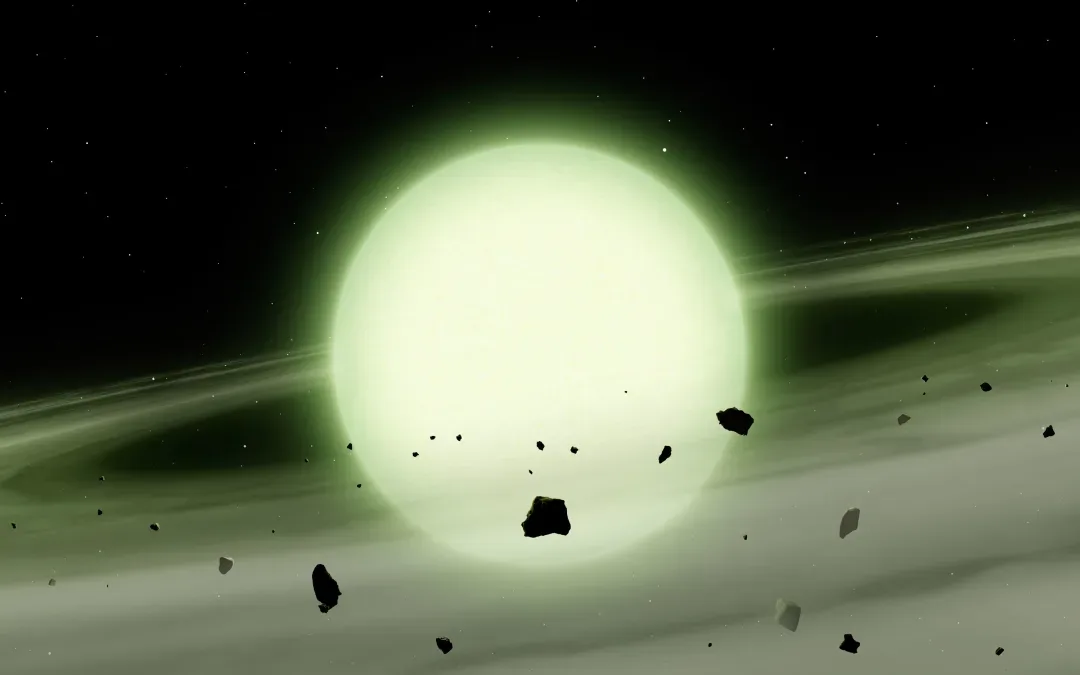
Astronomers have identified a white dwarf star that could appear green to the human eye, offering a new way to study the chemical composition of stars and the remnants of planets that once existed around them.
According to a report published by CNN, the research was conducted by Mark Hollands, an astronomer at the University of Warwick in the United Kingdom, and his colleagues. The team examined 151 nearby white dwarf stars and found that some had unusual colour characteristics.
The findings were published in the scientific journal RAS Techniques and Instruments (RASTI).
What Are White Dwarf Stars?
White dwarfs are the dense remnants of stars that have reached the final stages of their lives. Stars similar to the Sun can eventually evolve into white dwarfs after exhausting most of their nuclear fuel.
Although these stars are relatively small, they contain highly concentrated matter. Their light and chemical composition can provide valuable information about their evolution and the environments in which they formed.
Why Could the Star Appear Green?
The researchers found that the star contains elements including calcium, sodium and lithium. These elements can affect the wavelengths of light emitted by the star, potentially giving it an unusual appearance compared with more familiar stars.
Stars are commonly associated with colours such as orange, white and blue, but their apparent colours can vary depending on their temperatures and chemical composition.
The findings suggest that the unusual colour of this white dwarf may be linked to the elements present in its outer layers.
Clues About Ancient Planets
The researchers also identified elements such as iron and magnesium on the surfaces of some white dwarfs. These materials are commonly found in rocky bodies and may provide clues about planets or other rocky objects that once existed near the stars.
When a rocky object moves too close to a star, the star’s powerful gravitational forces can tear it apart. The resulting debris may then become incorporated into the star’s outer layers.
By analysing these materials, astronomers can investigate the composition of planetary bodies that may have existed in the distant past.
A Pinkish-Orange Star Also Identified
The study also identified another star that could appear pinkish-orange to the human eye.
According to the researchers, a relatively high abundance of carbon may explain its unusual colour.
These findings illustrate how the chemical composition of white dwarfs can influence their apparent appearance and provide information about the material surrounding them.
How Scientists Determine the Colours of Distant Stars
The stars examined in the study are too distant for scientists to assess their colours through ordinary direct observation. Instead, researchers analyse the light reaching Earth from these objects.
By separating the light into its component wavelengths, a technique known as spectroscopy, scientists can identify the elements present in a star and investigate its physical properties.
Colour, temperature and chemical composition can then help astronomers classify stars and understand why some appear different from others.
Independent Expert Urges a Measured Interpretation
Professor Agnes Kim of the University of Scranton in Pennsylvania, United States, who was not involved in the research, said the study built on existing knowledge.
She noted that the findings did not necessarily establish an entirely new understanding of stars, although the method used to investigate their colours was interesting.
Kim also observed that it was remarkable to consider how some of these distant stars might look green or pink if they were close enough to be viewed directly.
More Discoveries Could Follow
Hollands plans to study additional white dwarf stars, noting that many objects have yet to undergo detailed analysis of their light.
New scientific instruments could make it possible to investigate stars at greater distances and expand the number of objects whose light has been studied in detail.
Hollands estimates that the number of white dwarfs with detailed observational records could eventually increase by approximately tenfold.
If further research identifies more stars with similar characteristics, the number of potentially green-appearing white dwarfs could rise from one or two to around 10 or 20.
However, this remains a projection for future discoveries rather than a confirmed count of stars identified so far.