








Urdu Report Desk
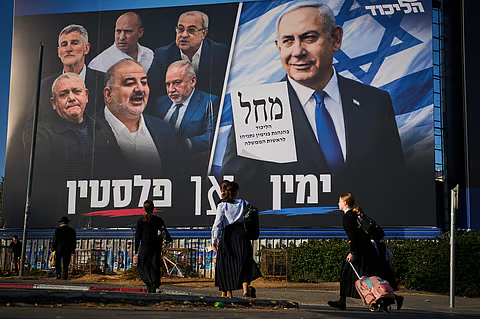
Isra*el’s election results have left both Prime Minister Benja*min Netany*ahu’s bloc and opposition leader Gadi Eisenkot short of a parliamentary majority, increasing the importance of Arab parties in negotiations over the formation of the next government.
According to the latest figures from Israel’s Central Elections Committee, 85.6% of votes had been counted, giving Netan*yahu’s bloc 53 seats, Eisenkot’s bloc 48 seats and Arab parties a combined 19 seats in the 120-member Knesset.
A government requires at least 61 seats, and neither political bloc has reached that threshold.
Changing Seat Projections
The seat distribution has shifted as vote counting has progressed. When 77% of votes had been counted, Netanyahu’s bloc was projected to win 54 seats, Eisenkot’s bloc 49 and Arab parties 17.
The latest figures put Netan*yahu’s bloc eight seats short of a majority, while the opposition bloc needs another 13 seats to reach the 61-seat threshold.
The results remain provisional, and the final distribution could change as counting continues. The official results will determine which political bloc is best placed to form a government.
Arab Parties Gain Political Leverage
Arab parties have emerged as a potentially decisive force, with the Joint List alliance and Mansour Abbas’s Ra’am party attracting renewed attention in the coalition negotiations.
Preliminary projections suggest Arab parties could secure 19 seats, potentially giving them considerable influence over the formation of the next government.
However, both Neta*nyahu and Eisenkot have previously ruled out directly bringing Arab parties into their governing coalitions, complicating efforts to assemble a parliamentary majority.
Netanyahu Claims Trump’s Support Helped
US President Donald Trump has claimed that his endorsement helped improve Netanyahu’s electoral position.
In a post on Truth Social, Trump referred to a comment suggesting that his support for “Bibi,” Netan*yahu’s nickname, had changed the course of the election.
Trump also wrote that Netanyahu, who had appeared headed for a clear defeat, was now in a position to secure a close contest or a victory.
Netan*yahu’s bloc, comprising right-wing and hardline Jewish parties, nevertheless appears to have fallen short of retaining its previous parliamentary majority.
Channel 12’s earlier exit polls and projections suggested that Netanyahu’s alliance could fall to around 52 seats, compared with 68 previously, with his Likud party projected to win 27 seats.
Eisenkot’s opposition alliance, Yashar, and other opposition parties were projected to secure 49 seats, with Eisenkot’s own party expected to win between 21 and 22.
Record Voter Turnout
Voter turnout in the election reached 77.7%, the highest rate since 1999, according to the Central Elections Committee. More than 5.69 million people cast their ballots.
The election has produced a closely divided parliament, raising the prospect of difficult negotiations among political parties before a new government can be formed.
Netanyahu Rejects Cooperation With Arab Parties
Speaking in Jerusalem on Wednesday morning, Netanyahu acknowledged the decline in his bloc’s projected seats but argued that the results showed he retained majority support among the Zionist and Jewish public.
He described Arab parties as anti-Zionist and rejected the possibility of forming a government with them.
Eisenkot, meanwhile, said voters had supported change, although securing the parliamentary majority needed to replace Netanyahu remained a challenge.
Pressure on Eisenkot to Negotiate With Arab Parties
Although Eisenkot also promised during the election campaign not to include Arab parties directly in his government, he is facing pressure from opposition voters and some potential allies to explore cooperation with Ra’am or the Joint List.
Such negotiations could help the opposition assemble the numbers needed to remove Neta*nyahu from power.
Mansour Abbas has indicated that he is willing to negotiate with the anti-Netanyahu bloc. Yusuf Jabareen, head of the Joint List, has also signalled openness to talks, saying that anyone seeking an alternative to Netany*ahu would have to negotiate with Arab parties.
Arab Leaders Criticise Netanyahu and Opposition
Sami Abu Shahadeh, head of the Balad party within the Joint List alliance, said Arab Isr*aeli citizens opposed Netan*yahu’s policies, which he described as racist and aggressive towards Palestinians.
Speaking to Al Jazeera, Abu Shahadeh argued that Eisenkot’s reluctance to govern with parties representing roughly 20% of the country’s population was becoming an obstacle to removing Netanyahu from office.
Arab party leaders have criticised both Netanyahu’s policies and the reluctance of some opposition figures to consider cooperation with Arab representatives.
Right-Wing Alliances Remain Uncertain
Despite the potential influence of Arab parties, it remains unclear whether hardline Jewish parties would accept an arrangement that relies on their support.
According to The Guardian, Net*anyahu is seeking to weaken Eisenkot’s alliance rather than negotiate directly with Arab parties. He is reportedly attempting to attract right-wing figures, including Avigdor Lieberman and Naftali Bennett, by appealing to opposition to Arab political participation.
Such manoeuvres could further complicate efforts by either bloc to secure a stable majority.
President Herzog Calls for Negotiations
Israeli President Isaac Herzog has urged all political parties to begin negotiations with an open mind to avoid sending the country into another general election.
Herzog said he would begin consultations on government formation once the official election results are received next week.
Under Israel’s political process, the president will invite a leader to attempt to form a government after the results are formally confirmed. Eisenkot could have four to six weeks to negotiate with other parties and assemble a coalition of at least 61 lawmakers.
If neither Eisenkot nor Netany*ahu can secure sufficient support and parliament fails to agree on a government, Israel could face another general election. Netanyahu would continue serving as caretaker prime minister until a new government is formed.