








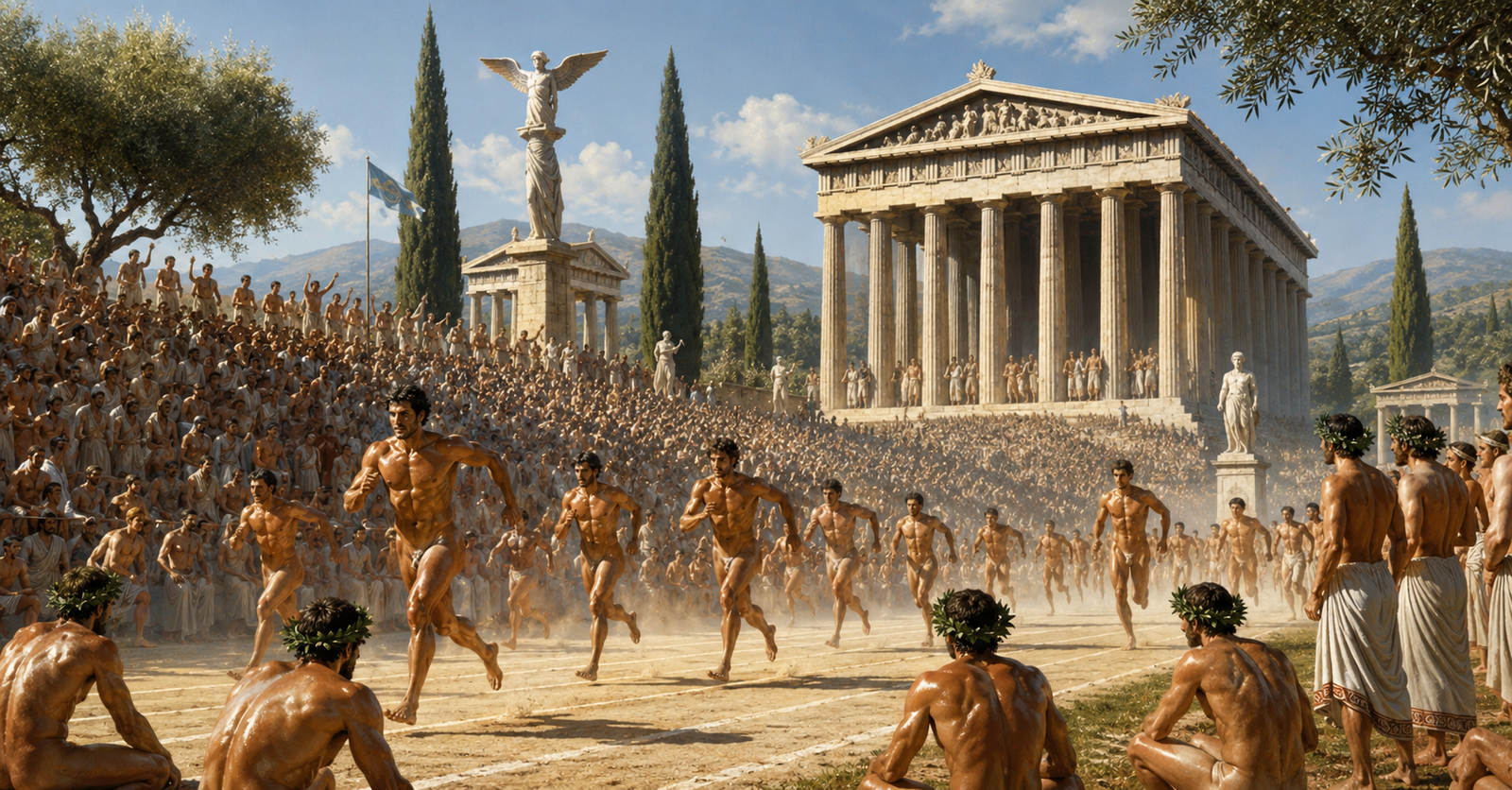
Nearly 3,000 years ago, in the ancient Greek city of Olympia, a sporting tradition began that would eventually evolve into the world’s biggest international celebration of sport.
Today, the Olympic Games bring together thousands of athletes from around the world, competing in modern stadiums before millions of spectators. But the origins of this global spectacle were remarkably simple.
There were no dozens of sports, no national teams and no gold, silver or bronze medals.
At first, there was just one race.
Yet one of the most fascinating chapters in the history of the ancient Olympics is the emergence, several decades later, of a tradition in which male athletes competed naked.
The First Olympic Competition
The first recorded Olympic Games traditionally date to 776 BC. They were held at Olympia in ancient Greece in honor of Zeus, the chief god of the Greek pantheon.
At the time, the Olympic programe consisted of just one event, known as the Stadion، a foot race of roughly 180 to 200 meters, with its distance linked to the length of the ancient Olympic stadium.
According to historical tradition, the winner of that first recorded race was Coroebus of Elis, who is generally regarded as the first recorded Olympic champion.
The Olympics, however, did not begin with athletes competing naked.
A Crucial Misconception
One of the most common misconceptions about the ancient Olympics is that athletes were naked from the very beginning.
There is no solid evidence that the athletes in the first recorded Olympic Games of 776 BC competed naked.
Historical traditions indicate that athletes in the earlier period used a loincloth or waist covering, referred to in Greek sources as perizoma, with some references also using the term diazoma.
In other words, there was a significant gap between the beginning of the Olympic Games and the later tradition of competing without clothing.
That change is generally associated with around 720 BC—roughly 56 years after the first recorded Olympics.
When Did Athletes Start Competing Naked?
Around 720 BC, during the 15th Olympiad, the practice of male athletes competing naked appears to have become established in Greek athletics.
The most famous ancient story connected with this change involves a runner named Orsippus (Orsippos) from Megara.
According to one version of the story, Orsippus was running in a race when his loincloth accidentally fell off. Rather than stopping, he continued and won.
Another version claims that he deliberately removed the garment because he believed running without it gave him greater freedom of movement and helped him run faster.
The incident was later associated with the emergence of the tradition of athletic nudity.
But there is an important historical caveat.
Ancient sources do not completely agree on how the practice began. Some traditions credit Acanthus of Sparta with introducing the change.
Therefore, it is more accurate to say that athletic nudity became firmly established around 720 BC, while the exact circumstances behind its introduction remain uncertain.
Why Did Greek Athletes Compete Naked?
To modern eyes, the practice can seem extraordinary. But ancient Greeks viewed the human body very differently from many societies today.
In There views in ancient times a strong, well-proportioned and highly trained male body was regarded as an expression of strength, beauty and physical perfection.
Athletic competitions provided an opportunity to demonstrate that physical excellence.
There was also a practical explanation.
During running, wrestling and other athletic events, clothing could interfere with movement. Competing without clothing allowed athletes greater freedom of movement and eliminated the risk of garments becoming tangled or restrictive.
But the practice was also deeply cultural.
In ancient Greek society, the naked male body was not necessarily viewed with the same sense of shame that it might be in many modern societies. Nudity was associated in certain contexts with athletic training, physical discipline, art and the ideal of the human form.
For the Greeks, the trained body could be something to admire rather than something to conceal.
The Origin of the Word “Gymnasium”
The ancient Greek word gymnos meant “naked.”
It is from this word that the term gymnasium ultimately developed.
Ancient Greek gymnasia were not simply gyms in the modern sense. They were important centres where young men trained their bodies, practised athletic skills and prepared for competitions.
The very word gymnasium, therefore, preserves a linguistic reminder of the ancient tradition in which athletes trained and competed without clothing.
Which Sports Were Played Naked?
After around 720 BC, nudity became associated with many of the major male athletic competitions.
These included:
- Running
- Wrestling
- Boxing
- Pankration
The pankration was one of the most brutal events of the ancient Games, combining elements of wrestling and boxing.
The pentathlon was another major athletic contest. It consisted of:
- Running
- Long jump
- Discus throw
- Javelin throw
- Wrestling
Evidence from ancient sources and artwork indicates that nudity was also associated with the athletic events of the pentathlon.
Events such as chariot racing and horse racing, however, were different because they involved riders, horses and chariots rather than the same type of direct athletic competition.
From One Race to an Entire Festival
The Olympics began with a single race in 776 BC, but the Games gradually expanded.
Over the centuries, additional running events, wrestling, boxing, pankration, the pentathlon, chariot racing and horse racing were introduced.
Olympia eventually became much more than a sporting venue.
It developed into a huge gathering where sport, religion, politics, culture and social life intersected.
Athletes and visitors travelled from different parts of the Greek world to participate in or witness the celebrations.
There Were No “Countries” as We Know Them Today
The ancient Olympics did not feature national teams like the modern Games.
Ancient Greece was divided into numerous independent or semi-independent city-states, known as poleis.
Athletes came from places such as Athens, Sparta, Corinth, Thebes and Elis, as well as other parts of the wider Greek world.
For that reason, there is no single reliable number of “countries” that participated in the ancient Olympics.
Athletes generally competed as representatives of their city or region, rather than a modern nation-state.
What About Women?
Women did not have the same right to participate in the main male athletic competitions of the ancient Olympic Games.
However, it would be misleading to suggest that women in ancient Greece had no sporting or athletic traditions whatsoever.
Women participated in other religious and cultural sporting traditions, and there were separate athletic celebrations associated with women.
This was very different from the modern Olympics, where women now compete in virtually every major Olympic sport.
What Did Olympic Champions Receive?
Ancient Olympic champions did not receive the gold, silver and bronze medals that are familiar today.
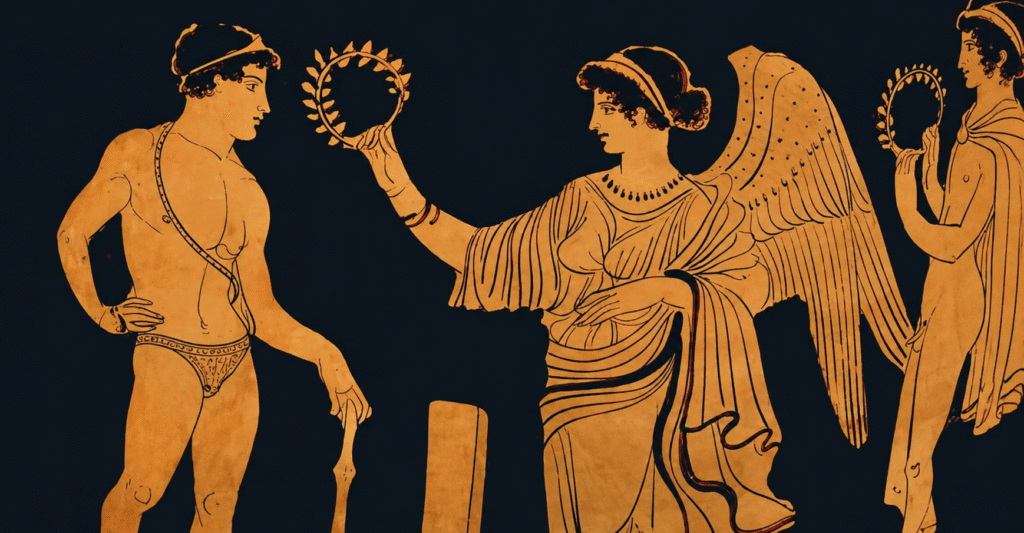
Instead, the victor received a crown made from olive branches.
But this simple-looking crown carried enormous prestige.
When a champion returned home, he could receive extraordinary honour, fame and, in some cases, financial rewards.
An Olympic victory could transform an athlete into a hero of his city.
Even Wars Could Not Stop the Olympics
The ancient Greek world was frequently divided by conflicts between rival city-states.
Yet the Olympic Games were connected with a tradition known as the Olympic Truce.
Its basic purpose was to help athletes, officials and visitors travel safely to Olympia.
The truce did not necessarily bring every war in the Greek world to a complete halt, but it was an important tradition intended to provide safe passage for those travelling to the Games.
For centuries, Olympia served as a rare meeting point where people from rival communities could come together under the banner of sport and religion.
A Tradition That Lasted Nearly 1,000 Years
The ancient Olympic Games were held every four years.
Beginning with the traditionally recorded date of 776 BC, the Games continued for centuries and survived in various forms for nearly a millennium.
Eventually, however, the political and religious landscape of the Roman Empire changed.
As Christianity spread and the Roman authorities increasingly moved against traditional pagan religious practices, the religious festivals associated with the ancient Greek gods came under pressure.
The Olympic tradition eventually disappeared.
Why Did the Ancient Olympics End?
The end of the ancient Olympic Games is commonly associated with AD 393 or 394, during the reign of the Roman Emperor Theodosius I.
This was a period when measures were being taken against traditional non-Christian religious practices.
The stadiums and sacred grounds of Olympia—where generations of athletes had raced, wrestled and fought for glory—eventually fell silent.
A tradition that had endured for almost a thousand years became part of history.
A Gap of Nearly 1,500 Years
After the ancient Olympics disappeared, the Games did not return in their ancient form for roughly 1,500 years.
Yet the idea of Olympia never completely vanished.
Across Europe, interest in ancient Greece and its sporting traditions gradually grew, and various attempts were made to revive the Olympic ideal.
In the 19th century, a French educator named Pierre de Coubertin played a crucial role in turning that idea into an organized international movement.
The Birth of the Modern Olympic Movement
In 1894, the International Olympic Committee (IOC) was established.
Its goal was to create an international sporting movement inspired in part by the ancient Olympic tradition, bringing athletes from different countries together for peaceful competition.
Just two years later, that vision became reality.
1896: The Olympics Return
In 1896, Athens, Greece, hosted the first modern Olympic Games.
After roughly fifteen centuries of silence following the end of the ancient Games, the Olympic tradition returned to its birthplace.
But almost everything else had changed.
Now athletes represented countries rather than ancient city-states. Women would gradually gain access to the Games, the number of sports would expand dramatically, and the modern medal system would emerge.
The Olympic Games had entered a completely new era.
Women Enter the Olympic Arena
Women made their official Olympic debut at the 1900 Paris Games, when they were permitted to compete in several events for the first time.
Initially, women participated in only a handful of sports, including tennis, golf, sailing, croquet and equestrian events.
Around 22 women took part, representing only a small fraction of the athletes competing at the Games.
Among those who made history were Hedwige Rosenbaum of Switzerland and Charlotte Cooper of Britain.
Charlotte Cooper won the tennis competition and became the first woman to win an Olympic championship title.
After centuries in which women had been excluded from the main athletic competitions of the ancient Olympics, the modern Games had finally begun opening their doors to female athletes.
From a Single Race at Olympia to a Global Phenomenon
Today, when athletes from around the world step onto an Olympic field, they carry with them a history far older than the modern Games themselves.
The story began nearly three thousand years ago in Olympia, with a single foot race.
There were no national flags, no television cameras, no billion-dollar stadiums and no gold medals.
Early athletes wore simple loincloths or waist coverings. Then, around 720 BC, the tradition of male athletes competing naked emerged and became an established feature of Greek athletics.
The Games expanded. New sports were added. Athletes travelled from different Greek city-states. Olympia became a centre of religion, culture and athletic excellence.
For almost a thousand years, the tradition survived.
Then, around AD 393/394, the ancient Games disappeared.
For nearly fifteen centuries, the stadiums of Olympia remained largely silent.
Until, in 1896, Athens brought the Olympics back to life.
What began as a simple race in an ancient Greek sanctuary had travelled across thousands of years of history to become one of humanity’s greatest sporting traditions.
And perhaps that is what makes the Olympics so extraordinary: beneath the modern stadium lights, national flags and record-breaking performances, there is still an echo of that ancient race at Olympia—the race that started it all.