







Urdu Report Desk
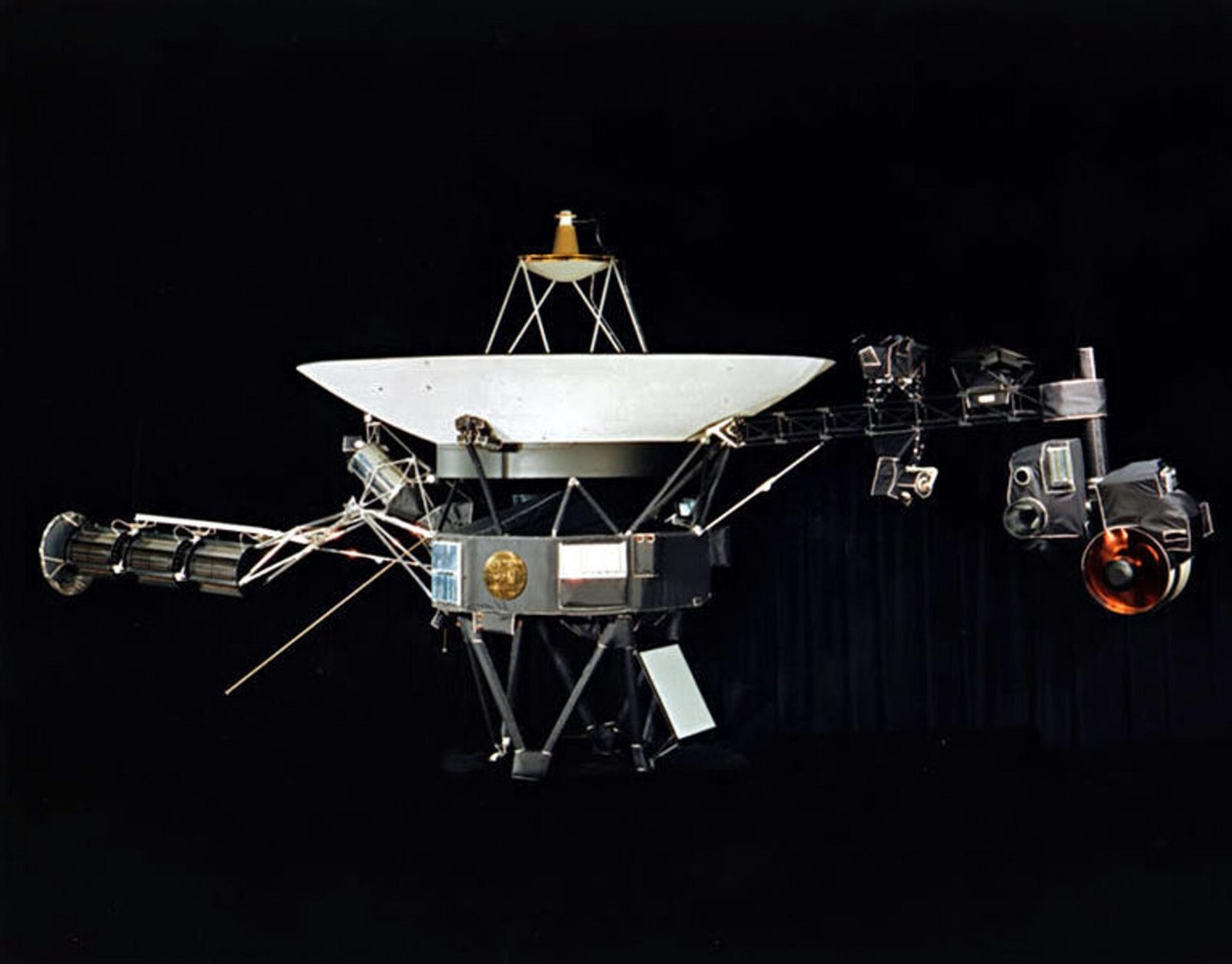
NASA’s Voyager 1 spacecraft has crossed a historic milestone by travelling one light-day away from Earth, becoming the most distant human-made object ever launched into space.
According to CNN, Voyager 1 reached approximately 16 billion miles (26 billion kilometres) from Earth shortly after 5:16 a.m. on Wednesday.
A light-day is the distance that light or a radio signal travels in 24 hours at the speed of light.
Voyager 1 has held the record as the most distant human-made object since 1998, when it overtook NASA’s Pioneer 10 spacecraft.
Karim Badaruddin, Voyager mission manager at NASA’s Jet Propulsion Laboratory, described the achievement as extraordinary, saying it had never happened before and might never happen again.
A 49-Year Journey Beyond Expectations
Voyager 1 was launched in September 1977, followed by its twin spacecraft, Voyager 2, a month later.
Both spacecraft were originally designed for five-year missions to study Jupiter and Saturn. However, their operational lifespans have exceeded expectations by almost ten times.
William Kurth, a research scientist at the University of Iowa, said the fact that both spacecraft were still delivering scientifically useful information after 49 years demonstrated the skill and dedication of the scientists and engineers who built them and continue to operate the mission.
Both spacecraft are now exploring interstellar space. Voyager 1 crossed the boundary of the heliosphere in 2012, while Voyager 2 followed in 2018.
The heliosphere is a vast protective region formed by the Sun’s magnetic field.
Communication with Earth Takes Two Days
NASA can still send commands to Voyager 1 and receive scientific data through its Deep Space Network.
However, the enormous distance creates a significant communication delay. A signal takes approximately 24 hours to travel from Earth to the spacecraft, while its response takes another 24 hours to return.
This means a complete communication exchange takes around two days.
Badaruddin said operating a spacecraft with such a long communication delay requires a completely different approach from conventional communication systems.
Just a few weeks ago, NASA went two days without receiving a signal from Voyager 1, raising fears that contact might have been permanently lost. However, communication was restored after 48 hours.
Declining Power Poses a Major Challenge
One of the biggest challenges facing NASA is the gradual decline in the spacecraft’s power supply.
Both Voyager spacecraft are equipped with three plutonium-powered radioisotope thermoelectric generators, which convert heat produced by radioactive decay into electricity.
When Voyager 1 was launched, its generators produced 470 watts of electricity. That output has now fallen to approximately 210 watts.
The spacecraft is losing around four watts of power every year.
Only two of Voyager 1’s original 10 scientific instruments are still operating. The magnetometer studies magnetic fields, while the Plasma Wave Subsystem measures the density of charged particles.
Despite its age, the spacecraft is travelling at approximately 61,155 kilometres per hour.
NASA’s ‘Big Bang’ Energy-Saving Operation
To extend the mission’s lifespan, NASA engineers carried out a major modification to Voyager 1’s power system during the summer.
The team switched off three non-scientific systems that consumed significant amounts of electricity and activated three alternative systems requiring less power.
The mission team named the operation "Big Bang”.
According to Badaruddin, the changes are expected to save approximately 10 watts of electricity, potentially extending the mission by another two and a half years.
He described the achievement of conserving power without shutting down any scientific instruments as a major success.
How Much Longer Can Voyager 1 Operate?
NASA cannot predict exactly how long Voyager 1 will remain operational.
According to the mission manager, scientists have repeatedly estimated over the decades that the spacecraft might continue functioning for another three to five years.
However, further improvements in energy conservation could extend its operational life.
Voyager 1 is currently travelling in the direction of the star Gliese 445, which is located more than 17 light-years from Earth.
Scientists estimate that the spacecraft will take approximately 40,000 years to reach its closest approach to the star, passing within about 1.7 light-years of it.
Voyager 2 is expected to reach a distance of one light-day from Earth in 2035. However, it remains uncertain whether both spacecraft will still be operational and capable of communicating with Earth by then.
Golden Records Carry Messages from Earth
Both Voyager spacecraft are carrying Golden Records, 12-inch gold-plated copper discs containing a collection of images, natural sounds, music and greetings in 55 languages.
The records also include messages from prominent personalities, including former US President Jimmy Carter.
The records were designed to preserve information about Earth and humanity for any potential extraterrestrial intelligence that might encounter the spacecraft.
Historic Discoveries of the Voyager Mission
The Voyager missions have made several important contributions to space science.
They helped discover new moons around Jupiter and Saturn, revealed active volcanoes on Jupiter’s moon Io and provided important information about the atmosphere of Saturn’s largest moon, Titan.
One of the mission’s most iconic achievements was Voyager 1’s famous 1990 photograph of Earth, known as the "Pale Blue Dot”.
The image shows our planet as a tiny blue speck against the vast darkness of space.
Researchers say both spacecraft continue to provide direct observations of interstellar space, offering scientific opportunities that cannot be achieved through observations using Earth-based telescopes alone.