






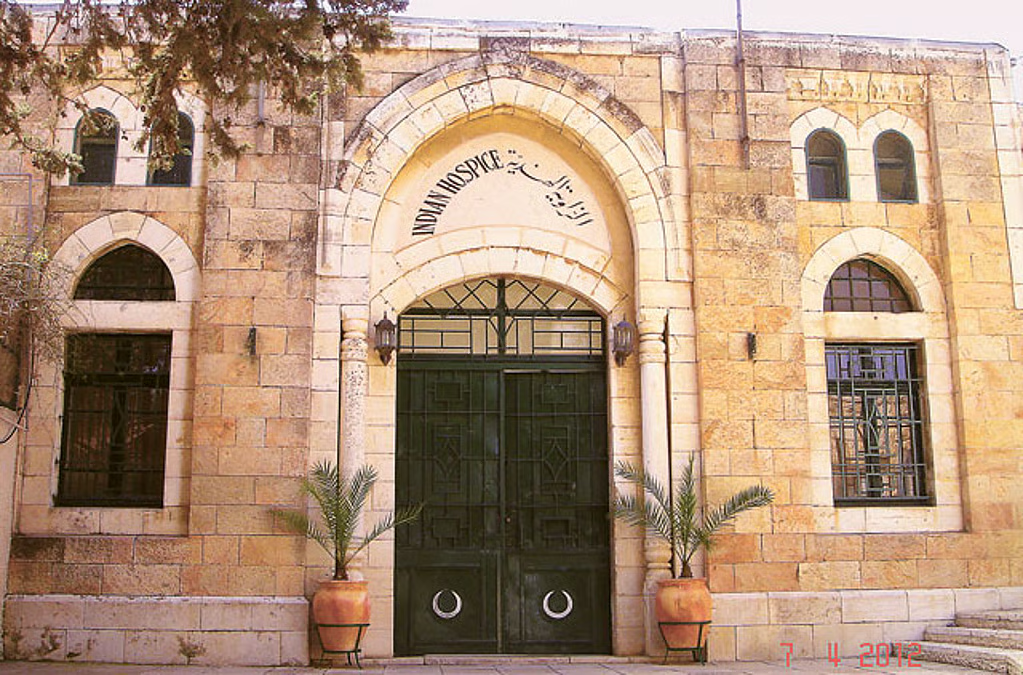
JERUSALEM: Hidden within the narrow streets of Jerusalem’s Old City, just northeast of the Al-Aqsa Mosque near Herod’s Gate, stands one of the oldest surviving symbols of the centuries-old relationship between South Asia and Palestine,the Zawiya al-Hindiyya (Indian Hospice).
For nearly 800 years, this historic Sufi lodge has represented the spiritual, cultural and historical ties connecting the Muslims of the Indian subcontinent,particularly those from Punjab,with Jerusalem. Although little known outside academic and religious circles, the site remains an enduring reminder of a shared Islamic heritage that predates modern nation-states by centuries.
The hospice is closely associated with Hazrat Baba Farid al-Din Masud Ganjshakar (RA) (1173–1265), one of the most influential Sufi saints in South Asian history and a leading figure of the Chishti Order. According to long-standing traditions, Baba Farid visited Jerusalem after performing Hajj and spent time in deep worship and spiritual retreat near Al-Aqsa Mosque.
Zawiya al-Hindiyya – Also Known as Zawiya al-Faridiyya
Historical traditions preserved in Sufi literature and Palestinian oral history suggest that Baba Farid arrived in Jerusalem during the early 13th century. It is believed that he spent forty days in prayer, meditation and devotion inside a small underground stone chamber close to Al-Aqsa Mosque.
Over time, the place became known as Zawiya al-Faridiyya, named after Baba Farid himself. As increasing numbers of Muslim pilgrims, scholars, traders and Sufi travelers from the Indian subcontinent began staying there during their visits to Jerusalem, the hospice gradually became famous as Zawiya al-Hindiyya, meaning "The Indian Hospice.”
While historians acknowledge that some details of Baba Farid’s stay in Jerusalem remain part of religious tradition rather than firmly documented historical evidence, the existence of the Indian Hospice itself is well established and has been recorded by numerous researchers studying Jerusalem’s Islamic heritage.
According to traditional accounts, Baba Farid devoted his time in Jerusalem to prayer, fasting and spiritual reflection. Some narratives also describe him helping clean the stone courtyards surrounding Al-Aqsa Mosque, symbolizing humility, service and devotion,qualities that later became hallmarks of the Chishti Sufi tradition throughout South Asia.
His journey to Jerusalem represents more than a personal spiritual experience. It reflects the centuries-old movement of scholars, mystics and pilgrims between the Middle East and the Indian subcontinent, strengthening religious and cultural ties that continue to be remembered today.

The Life of Baba Farid: The Saint Who Shaped South Asian Sufism
Hazrat Baba Farid al-Din Masud Ganjshakar (RA) (1173–1265) is regarded as one of the greatest Sufi saints, poets and spiritual reformers in the history of the Indian subcontinent. A leading figure of the Chishti Sufi Order, he played a pivotal role in spreading Islam through compassion, humility, tolerance and service to humanity rather than political or military influence.
Historical sources place his birth in the region that is now part of Pakistan. He later settled in Pakpattan, Punjab, which became the center of his spiritual mission and remains one of the most important pilgrimage destinations for millions of devotees from Pakistan, India and across the world.
Baba Farid’s teachings emphasized love for humanity, remembrance of God, generosity, self-discipline and respect for people of all faiths. His message transcended religious and cultural boundaries, making him one of the most widely respected spiritual figures in South Asian history.
His Punjabi verses are considered among the earliest masterpieces of Punjabi literature. Many of his hymns were later incorporated into the Guru Granth Sahib, the sacred scripture of Sikhism, making him one of the few Muslim saints whose poetry holds a revered place in another major world religion. This unique recognition reflects the universal appeal of his teachings and the spirit of interfaith harmony that he inspired.

The Indian Hospice: A Spiritual Home for South Asian Pilgrims
Following Baba Farid’s association with Jerusalem, the site that later became known as Zawiya al-Hindiyya (Indian Hospice) evolved into an important sanctuary for Muslims arriving from the Indian subcontinent.
For centuries, scholars, Sufi saints, merchants and Hajj pilgrims from present-day Pakistan, India and Bangladesh found accommodation, spiritual guidance and hospitality within its walls during their visits to Jerusalem and Al-Aqsa Mosque.
Because of its long-standing connection with visitors from South Asia, the building became widely known as the Indian Hospice. It served not only as a place to stay but also as a center for religious learning, spiritual reflection and cultural exchange between the Middle East and the Indian subcontinent.
Throughout its remarkable history, the hospice survived the Crusader era, the Mamluk Sultanate, the Ottoman Empire, the British Mandate and the modern Palestinian period. Despite centuries of political upheaval, wars and changing rulers, the institution has remained a powerful symbol of the enduring relationship between Jerusalem and South Asian Muslims.
Today, historians regard the Indian Hospice as far more than a historic building. It stands as a living monument to nearly eight centuries of shared religious heritage, Sufi traditions and cultural connections linking Palestine with the Indian subcontinent.
Its continued existence highlights the deep historical roots of Muslim travel, scholarship and spiritual exchange between South Asia and the Holy City, long before the emergence of modern national borders.

Sheikh Nazir Ansari: Guardian of an Eight-Century-Old Legacy

Today, Sheikh Nazir Ansari serves as the custodian of Zawiya al-Hindiyya, continuing a family tradition that has preserved one of Jerusalem’s most significant South Asian Islamic heritage sites for generations.
He assumed responsibility for the hospice after his father, Sheikh Muhammad Munir Ansari, who devoted much of his life to protecting and maintaining the historic complex.
Contrary to a common misconception, the Ansari family did not migrate to Jerusalem in recent times. Historical records indicate that the family has lived in the Holy City for several generations, dedicating themselves to the care of the Indian Hospice and welcoming pilgrims, researchers, historians and visitors from around the world.
Under Sheikh Nazir Ansari’s stewardship, the hospice continues to symbolize the enduring spiritual, historical and cultural relationship between Pakistan, India, Bangladesh and Pale*stine.
The Tragedy of the 1967 War
The history of the Indian Hospice is also marked by one of the darkest chapters in Jerusalem’s modern history.
Recalling the 1967 Arab-Isra*eli War, Sheikh Muhammad Munir Ansari described how the conflict forever changed life at the centuries-old hospice.
According to his account, fighting reached the area on June 5, 1967. The following day, Jordanian soldiers sought shelter inside the hospice. By the next morning, they had withdrawn, leaving behind their uniforms and weapons.
Local residents later used some of those abandoned weapons to fire at advancing forces. In response, Isr*aeli forces launched heavy shelling on the Indian Hospice.
During the bombardment, Sheikh Muhammad Munir Ansari repeatedly moved his family from one room to another in an attempt to protect them. Eventually, a shell struck near the chamber traditionally associated with Baba Farid, causing part of the building to collapse.
He suffered severe burns to his hands, face and hair while rescuing survivors trapped beneath the rubble. Tragically, his mother, sister and two-year-old nephew lost their lives in the attack.
Despite the devastating destruction and personal loss, the hospice survived the war and continues to stand as a powerful reminder of Jerusalem’s turbulent history and the resilience of those who have protected this sacred site for generations.
A Living Symbol of Shared Heritage
Today, visitors walking through the narrow alleys of Jerusalem’s Old City often discover the Indian Hospice as a quiet sanctuary filled with centuries of history.
Beyond its stone walls lies a remarkable story of faith, pilgrimage, scholarship and cultural exchange connecting the Holy Land with the Indian subcontinent.
For many historians, the hospice represents not merely an ancient building but a living testament to the centuries-long relationship between South Asian Muslims and Jerusalem,a bond shaped by spirituality, hospitality and shared religious traditions that continues to endure despite wars and political change.
Read More
How Tariq ibn Ziyad’s Conquest Gave Gibraltar Its Name – urdureport.com
Bhagat Singh of Lyallpur: The Revolutionary Who Asked to Be Shot Instead of Hanged – urdureport.com
Historians: A Rare Symbol of South Asia’s Spiritual Legacy in Jerusalem
Researchers who have studied Jerusalem’s Islamic heritage describe Zawiya al-Hindiyya (Indian Hospice) as one of the oldest surviving institutions reflecting the historic relationship between the Indian subcontinent and the Holy City.
While historians note that some details surrounding Baba Farid’s visit to Jerusalem are rooted in Sufi tradition and remain the subject of academic discussion, there is broad agreement that the Indian Hospice itself is an authentic historical institution with centuries of documented significance.
Over the years, scholars have highlighted the hospice as evidence that the relationship between South Asia and Jerusalem extends far beyond modern politics. Instead, it reflects centuries of pilgrimage, scholarship, spirituality and cultural exchange that connected Muslims from the Indian subcontinent with one of Islam’s holiest cities.
The hospice continues to attract historians, researchers and visitors interested in exploring the rich legacy of Islamic civilization and the historical links between Pakistan, India, Bangladesh and Palestine.
A Living Bridge Between Two Regions
For many visitors, Zawiya al-Hindiyya is more than a centuries-old building hidden inside Jerusalem’s Old City.
It represents a living bridge connecting two regions through shared faith, history and human interaction. For generations, pilgrims traveling from South Asia found not only accommodation within its walls but also a spiritual home during their journeys to Al-Aqsa Mosque.
The story of the Indian Hospice reminds us that the relationship between the Indian subcontinent and Jerusalem was built on devotion, learning, hospitality and mutual respect long before the emergence of modern borders.
As one of Jerusalem’s lesser-known yet historically significant landmarks, the hospice preserves an extraordinary chapter of Islamic history,one that continues to inspire researchers, pilgrims and admirers of Sufi heritage around the world.
Nearly eight centuries after it first became associated with Baba Farid, the Indian Hospice remains a symbol of unity, spirituality and the enduring cultural bonds linking South Asia with the Holy Land.