







By Urdu Report Editorial Team
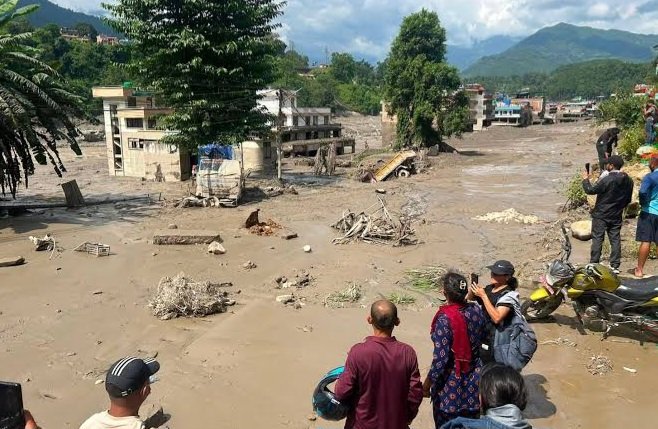
The death toll from devastating floods in Nepal has risen to 734, while 2,498 people remain missing, according to the country’s disaster management agency.
Rescue operations entered their fifth day, with more than 3,700 people moved to safer locations so far. Severe flooding and landslides continue to make access to affected areas difficult.
More than 18,000 rescue workers are involved in the operation. However, bad weather and difficult terrain are slowing relief efforts. Authorities have also increased the use of helicopters to deliver aid and are considering drones for rescue operations in some areas.
Foreign nationals among those affected
A large number of foreign nationals have also been affected by the floods. Nepal Tourism Board data shows that 261 foreign nationals have been rescued, while another 320 remain missing.
Those rescued include 167 Indians, 40 Chinese, eight Ukrainians, four Germans, four Maltese and three Americans.
Rescue teams search for trapped workers
Rescue workers are trying to reach employees of hydropower projects who are believed to be trapped inside tunnels filled with flood debris.
Nepal’s government says more than 100 workers may still be alive and trapped in several tunnels. Major rescue efforts are focused on the Trishuli 3A and 3B hydropower projects.
According to the National Disaster Risk Reduction and Management Authority, 933 hydropower workers have been missing since a large wave of mud and debris struck on Wednesday morning.
At Trishuli 3A, army rescue teams used drills on Saturday evening to create a passage into the upper section of a mud-filled tunnel. They then began sending air and cameras inside.
Heavy overnight rain and rising river levels later disrupted the operation. The Nepal Army said water levels rose after heavy rain began at around 2am, flooding the excavation area.
International teams join rescue efforts
Images released by the disaster authorities showed workers moving through mud and clearing large rocks deposited by the floods.
Nepal’s Prime Minister’s Office said rescue teams faced continuous rain and difficult conditions but worked throughout the night to search for and rescue people who may still be trapped. Modern search cameras and specialised monitors are also being used.
The US Geological Survey said the disaster near the China-Nepal border was caused by a glacier collapse. Specialised tunnel rescue teams from India and China have also joined the relief operation.
Nepal’s specialised mountain rescue teams, which assist climbers on the world’s highest peaks, including Mount Everest, are also joining the search at another affected hydropower project.
Hydropower projects badly affected
The Nepal Electricity Authority said 11 hydropower stations and one solar power station have stopped operating. Together, the facilities have a generation capacity of 431.1 megawatts.
The authority said the affected facilities account for about 10% of Nepal’s total installed power generation capacity. Another 15 hydropower projects under construction have also been affected, with a combined planned capacity of 470 megawatts.