









By Tariq Iqbal Chaudhry

A Court Case That Changed the Course of History
Some events in history appear to be the personal story of a single individual, yet they ultimately reshape the destiny of entire regions. The Islam Bibi Case of 1936 in Bannu, then part of British India’s North-West Frontier Province (NWFP), was one such turning point.
What began as a legal dispute over the religious conversion and marriage of a young woman soon evolved into a major political and religious controversy. The case ignited long-standing resentment across the tribal belt and transformed Mirzali Khan Wazir, better known as the Faqir of Ipi, into one of the most determined symbols of armed resistance against British colonial rule.
Many historians regard the case as one of the key events that triggered the Waziristan Campaign (1936–1939), a conflict that would occupy British military forces for years and leave a lasting impact on the history of the region.
From Ram Kaur to Islam Bibi
On March 5, 1936, a young Hindu woman named Ram Kaur, also referred to in some historical accounts as Kauri, left her home in Jandu Khel, Bannu, with Amir Noor Ali Shah, a local Muslim schoolteacher who belonged to a Syed family.
According to historical records, she voluntarily embraced Islam and adopted the name Islam Bibi. Shortly afterward, the couple married under Islamic law and began a new life together.
However, what appeared to be a private personal decision quickly developed into one of the most controversial legal cases in British India. The conversion, marriage and questions surrounding her age soon became the focus of intense public debate involving religion, colonial law and tribal customs.
A Mother’s Complaint and the British Court
The controversy deepened when Mansa Devi, the young woman’s mother, filed a complaint with the British colonial authorities, alleging that her underage daughter had been abducted and forcibly converted to Islam.
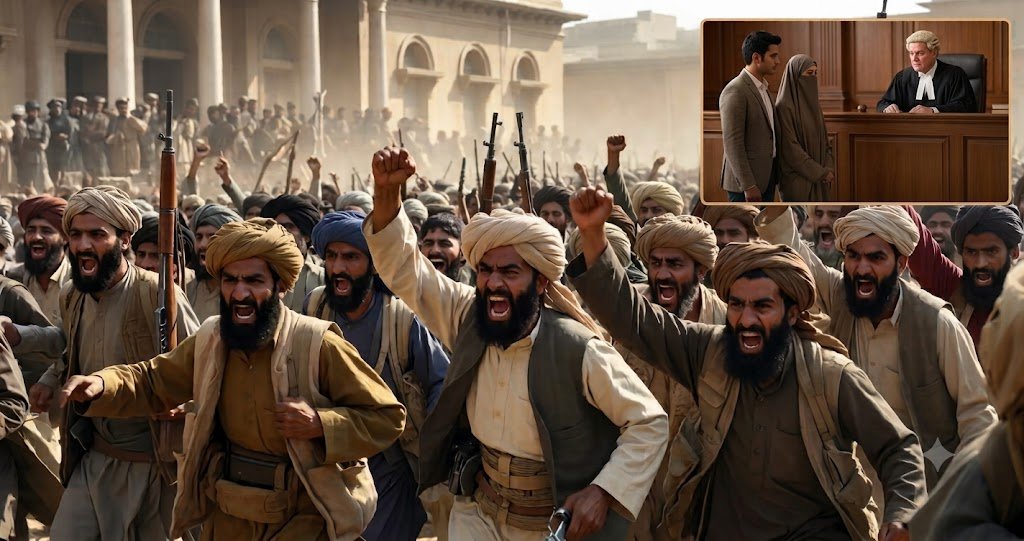
The case was brought before a British court in Bannu, attracting widespread attention throughout the region. Hundreds of tribal elders, religious scholars and local residents gathered to witness the proceedings, recognizing that the verdict could have far-reaching consequences beyond the fate of one family.
During the hearing, Islam Bibi clearly stated before the court that she had accepted Islam of her own free will and wished to remain with her husband.
Despite her testimony, the British court ruled that she was a minor, declared the marriage invalid, convicted Amir Noor Ali Shah on charges of abduction, and ordered that Islam Bibi be returned to her Hindu family.
The verdict immediately sparked outrage across the tribal areas, where many viewed the decision not merely as a legal judgment but as interference in religious freedom and Islamic personal law.
The Verdict That Ignited a Tribal Uprising
As soon as tribal elders and religious scholars left the courtroom, they openly condemned the verdict. They argued that once Islam Bibi had voluntarily embraced Islam, returning her to a non-Muslim family violated both Islamic principles and the Pashtun tribal code of Pashtunwali.
News of the judgment spread rapidly across Waziristan and neighboring tribal regions, fueling public anger against British colonial authorities. What had begun as a family dispute soon evolved into a powerful symbol of resistance against foreign rule.
Within weeks, the Islam Bibi Case had become one of the most widely discussed issues across the tribal belt, strengthening calls for unity among the Pashtun tribes.
The Rise of the Faqir of Ipi

For many tribal Muslims, the court’s decision was far more than a legal ruling. It was widely perceived as an attack on religious freedom and an intrusion into Islamic law and tribal traditions.
Amid this growing unrest, Mirzali Khan Wazir, later known throughout history as the Faqir of Ipi, emerged as the leading voice of resistance.
A respected religious leader from the village of Ipi in North Waziristan, he declared that the British court’s decision represented an assault on Islam and called upon Muslims to unite in defense of their faith and traditions.
His message resonated across the tribal areas. Long-standing rivalries between the Wazir, Mahsud, Bhittani, and several other Pashtun tribes gradually gave way to a common cause as thousands rallied behind him.
What began as opposition to a single court ruling soon transformed into one of the largest anti-colonial movements in the tribal regions during the British Raj.
Faqir of Ipi’s Resistance Against British Rule
Mirzali Khan Wazir is widely regarded as one of the most influential anti-colonial leaders in the history of the Indian subcontinent.
Following the Islam Bibi Case in 1936, he launched an armed resistance against British rule that quickly evolved into a broader movement for tribal independence and self-governance.
Relying on guerrilla warfare and his deep knowledge of the mountainous terrain, the Faqir of Ipi successfully challenged British military operations for years. Despite repeated campaigns involving thousands of troops, British authorities failed to capture him.
Even after the creation of Pakistan in 1947, he continued advocating for the political autonomy of the tribal regions. Following his death in 1960, he remained a prominent figure in the history of resistance movements in South Asia.
Today, historians continue to recognize the Faqir of Ipi as one of the most determined opponents of British colonial rule, whose leadership inspired generations of anti-colonial activists across the region.
The Waziristan Campaign and British Military Operations
As resistance gathered momentum under the leadership of the Faqir of Ipi, the British colonial administration responded with one of its largest military operations in the tribal areas.
The British Army launched extensive campaigns in the Khaisora Valley and other parts of Waziristan in an effort to crush the growing rebellion. Military forces established new outposts, imposed heavy fines on local tribes, demolished numerous villages, and tightened administrative control across the region.
The campaign also involved the Royal Air Force (RAF), which carried out aerial bombing raids against suspected rebel positions. These operations marked one of the earliest large-scale uses of air power by the British Empire in the tribal belt.
Despite overwhelming military superiority, British forces struggled to defeat the resistance. The rugged mountainous terrain, combined with widespread tribal support for the Faqir of Ipi, enabled the movement to survive repeated offensives.
Using guerrilla tactics, the Faqir of Ipi and his followers remained active for years, frustrating British commanders and turning Waziristan into one of the most challenging regions for the colonial administration.
https://t.co/tTfE2lO7Jr
A Hindu convert girl eloped with a Muslim Pathan in Bannu during 1936, British court annulling relation triggered revolt against British rule in NWF tribal belt.#BritishNews #indopk #history #frontier #britishempire#tribesmen #tribal #pathan pic.twitter.com/Vl3RRHtTMr— Erfan Khan (@ErfanKhaanz) July 19, 2026
Legends That Strengthened His Influence
As the conflict continued, the Faqir of Ipi became the subject of numerous stories and legends throughout the tribal areas.
Many local people believed he possessed extraordinary spiritual qualities. Popular folklore claimed that his prayers could protect fighters from bullets, that bombs failed to harm those under his spiritual protection, and that divine assistance guided his followers during battles.
Although historians have found no documentary evidence to verify these supernatural accounts, they agree that such stories significantly enhanced his reputation and strengthened public support for the resistance movement.
The combination of religious leadership, tribal unity, and popular belief transformed the Faqir of Ipi into more than a military commander. He became a powerful symbol of defiance against British colonial rule and an enduring figure in the collective memory of the Pashtun tribal regions.
Read More :
How Tariq ibn Ziyad’s Conquest Gave Gibraltar Its Name – urdureport.com
Baba Farid’s Historic Connection with Al-Aqsa Mosque Lives On – urdureport.com
Bhagat Singh of Lyallpur: The Revolutionary Who Asked to Be Shot Instead of Hanged – urdureport.com
A Turning Point in Colonial History
Modern historians generally agree that the Islam Bibi Case became one of the defining events that triggered the Waziristan Campaign (1936–1939) and intensified resistance to British rule in the tribal regions.
The controversy united religious leaders, tribal elders, and ordinary people around a common cause, transforming what had begun as a personal legal dispute into a wider movement against colonial authority. The case also elevated the Faqir of Ipi from a respected religious figure to one of the British Empire’s most formidable opponents on the North-West Frontier.
For years, British military and political authorities viewed him as one of the greatest security challenges in the region, committing significant resources to suppress the insurgency. Yet his influence continued to inspire resistance across Waziristan and beyond.
Historical Debate and Legacy
Some aspects of the Islam Bibi Case—including her exact age, the legal proceedings, the details of her marriage, and the sequence of certain events—remain the subject of historical debate. Different historical sources present varying interpretations, reflecting the complexity of the period.
Nevertheless, most historians agree on one central conclusion: the case played a significant role in igniting resistance in Waziristan and helped shape the emergence of the Faqir of Ipi as a leading anti-colonial figure.
Today, the Islam Bibi Case is remembered not simply as a courtroom dispute but as a landmark episode in the history of British India. It highlights the intersection of religion, colonial law, tribal customs, and political resistance, offering valuable insight into the forces that shaped the struggle against British rule on the North-West Frontier.
Nearly nine decades later, the story continues to attract the attention of historians, researchers, and readers interested in the history of British India, Waziristan, and the broader anti-colonial movement in South Asia.